
As the Definition of Success Changes: Fluidity, Orchestration, and Impact

There was a time when success was as simple as a chart hanging on the wall. Boxes were checked, tasks were completed, and calendars moved forward. The world felt consistent, predictable—almost like a mathematical equation. In those earlier eras shaped by control, predictability, and process discipline, success meant minimizing errors and running processes flawlessly.
Then the game changed.
Waves grew higher, uncertainty increased, and plans fell behind. Success was no longer a destination—it became the ability to change direction in the middle of the game. The definition of success shifted toward agility, autonomy, initiative, and meaning-making. Instead of asking, “Tell me what to do,” the real question became, “How can I create value?”
And now, the door to an entirely new era has opened. With the age of AI came another major shift—a new mode: AI–Agentic Multiplayer. The challenge is no longer completing tasks but managing an ecosystem, orchestrating algorithms, and designing risk and value simultaneously. Success is being redefined as the ability to:
- Be flexible—and beyond that, fluid
- Create value through dynamic goal-setting
- Orchestrate multiple AI systems
- Take responsibility and own outcomes
This is the era of those who can remain fluid while empowered by AI—those who make decisions and do not shy away from results.
The JARVIS Fallacy: The Power Is Not in AI, but in the Mind That Directs It
There is a critical distinction here. JARVIS was not what made Iron Man powerful. The power came from how Tony Stark directed JARVIS.
JARVIS:
- Processes data
- Presents probabilities
- Generates alternatives
But:
- Tony defines the goal
- Tony sets the priorities
- Tony takes responsibility for the outcomes
This is exactly what AI orchestration means in agentic organizations. It is not about having AI—it is about guiding AI with the right questions, in the right context, for the right purpose.
The Customer Relationship: Not a Need, but an Experience
Customers no longer expect their needs to be merely met; they expect meaningful, differentiated, and memorable experiences. This fundamentally transforms how we work. It is no longer possible to create these experiences using yesterday’s habits, standard processes, or predefined scenarios.
We cannot move into the future with yesterday’s scripts.
That’s why we must:
- Be experimenters rather than followers
- Shape the flow rather than merely adapt to it
The Matrix Metaphor: Perfect, but Not Agentic
The Matrix was a flawless control system—but it was not agentic. Because agentic organizations survive not through control, but through meaning and choice. The Matrix predicted everything and controlled everything, yet it could not truly adapt to change. And that is precisely the risk organizations face today: trying to control everything means not being agentic.
A Point Highlighted by McKinsey
A key insight from McKinsey’s reports is this: there is not yet an iconic example for this era.
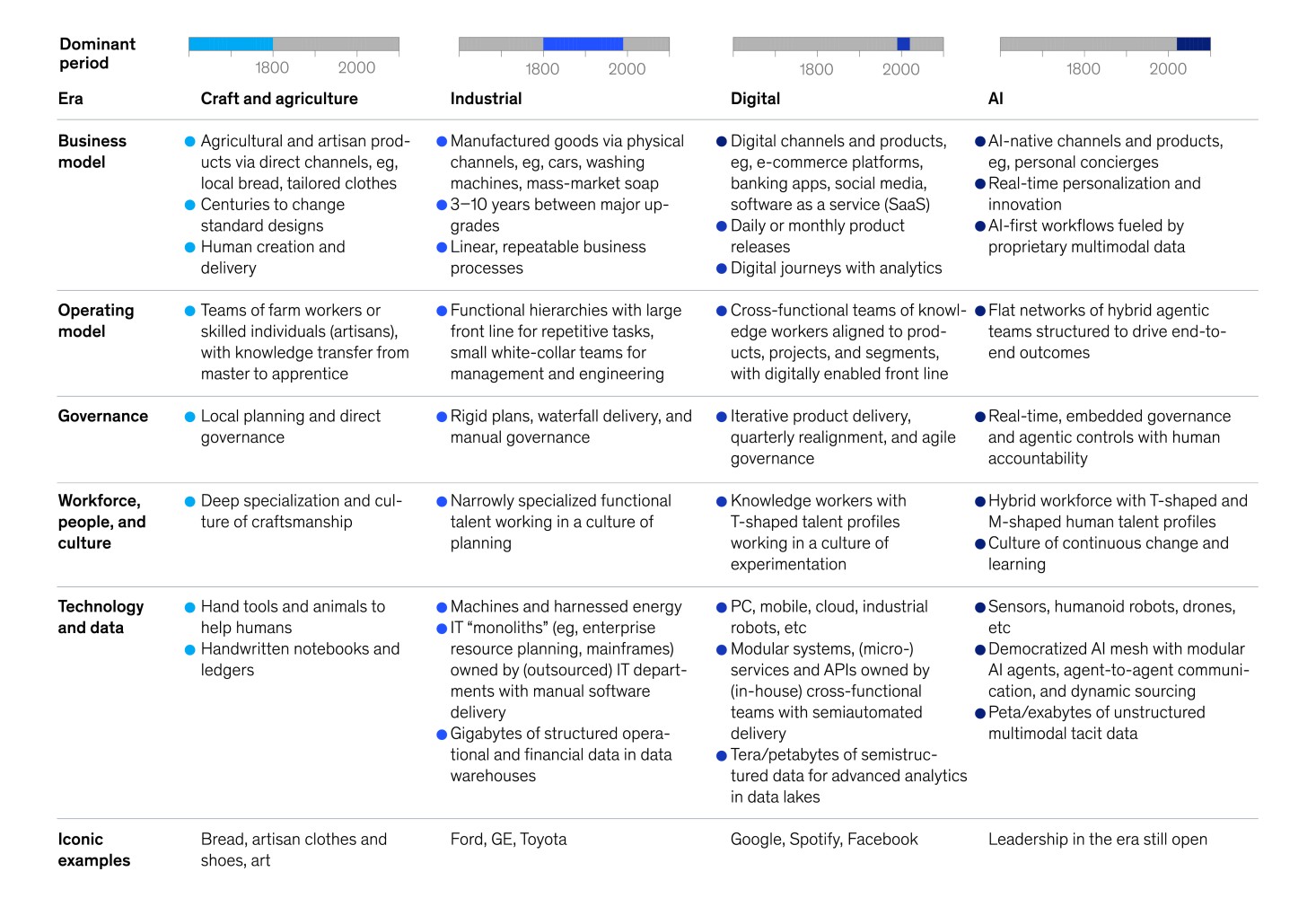
Every paradigm shift has its icons—but this time, they have not yet emerged. The reason is simple: it is still very new. We are only at the beginning. This era is:
- Not stable enough to simply follow
- Not clear enough to copy
- Not yet fully defined in its processes
For this reason, each organization will create its own iconic journey—shaped by its own fluidity, experience, and context.
This is no longer the era of “Let someone else do it first, then I’ll adopt the best version.” We have incredibly powerful tools—but the playing field is different for everyone.
To stand out in this paradigm shift—and to become the icons of this era—organizations will need:
- The ability to combine diverse capabilities rather than deepen in only one (especially AI orchestration)
- A continuously evolving mindset instead of a fixed one
- Prioritization and value-driven decision-making
- The ability to maintain meaningful direction under changing conditions rather than chasing fixed targets
- More frequently updated strategies
- More decentralized decisions
- Autonomy within a safe and trusted framework
Everything we have discussed and begun to practice so far now becomes a supporting force in shaping the icons of this new era.
It is time to say:
- Not “We met the need,” but “We built self-learning systems with contextual awareness and created meaningful experiences.”
- Not “We completed the task,” but “We generated value through distributed decision-making between humans and AI.”
- Not “We followed the plan,” but “We designed strategy based on real-time signals and managed value and risk together.”
- Not “We have AI tools,” but “We have AI teammates who co-decide, co-create, and share responsibility and risk.”
This is not the time to simply do more work—it is the time to create the right impact.
And perhaps the most striking truth of this journey is this: there are no icons of this era yet. Because this time, icons will not be copied—they will be created.
Science fiction has been telling us the same thing for years: the future will not belong to those who complete more tasks, but to those who make more conscious decisions.
And… agentic organizations will be the true reflection of that future in the world of work.
Comment(s)